Weatherend
The Beast in the JungleWeatherend is the grand house where John Marcher and May Bartram renew their acquaintance and make the agreement that shapes their companionship. Its many rooms, accumulated art, and autumn light provide more than a picturesque setting: the house moves the pair from the visitors’ public tour into a private conversation about Marcher’s imagined future, a suspense whose meaning changes radically in retrospect.
House and Collections
Weatherend is presented as an almost famous country house, notable for its extensive rooms and the intrinsic features, pictures, heirlooms, and other treasures gathered within it. Visitors invited from another house come to luncheon and then disperse to view the building and its contents. The scale of the rooms lets them wander, linger, and inspect objects in corners; Marcher compares some visitors’ absorbed attention to the prospecting gaze of people at a much-advertised sale, an impression sharpened by his discomfort among those who seem either to know too much or nothing at all.
The rooms press poetry and history upon Marcher, who needs to stray apart before he can feel properly related to them. One room, notable for a fine portrait above the chimney-piece, becomes the setting for his first private exchange with May. In the fading October light, a red shaft from beneath a low, dark sky reaches across old wainscoting, tapestry, gilding, and color. The house’s abundance makes it easy for visitors to find a reason to linger; in this room, that lingering becomes the occasion for a conversation neither Marcher nor May treats as merely part of the tour.
May Bartram at Weatherend
When Marcher first sees May again, he tries to place her within the household. He supposes that she may be a poor relation or a dependent who helps show the house, explain the building and furniture, identify the pictures, and answer visitors’ questions, even about the grounds’ supposed ghost. These are his inferences, not facts he initially knows. He also senses that May’s circumstances are harder than her composed appearance suggests, and that the years between their earlier meeting and this afternoon have brought her suffering.
The house’s public role gives May a plausible reason to approach guests, but the scene turns on the distinction between that apparent duty and her personal recognition of Marcher. She remembers their former meeting much more accurately than he does and understands that he has not recovered the thread of their acquaintance. Rather than simply supplying it, she waits for him to make the effort. Once they are alone, she lets his recollections emerge and corrects his errors: they met in Naples, not Rome; nearly ten years earlier, not eight; and the storm that drove them into shelter occurred at Pompeii. Weatherend thus brings an imperfect memory into contact with the person who has preserved its details.
The October Conversation and Pact
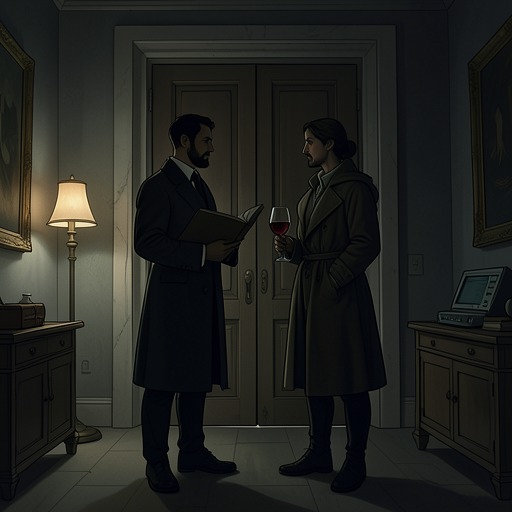
After luncheon, as the other visitors move through the house, Marcher and May find themselves alone in the portrait room and have, before speaking, effectively chosen to remain there together. May’s voice completes the recognition that her face had only half awakened in him. Their exchange then moves from the past to the future Marcher has long feared: he describes an event he expects to face or suffer, one that might destroy his consciousness, annihilate him, or alter the foundations of his life. May proposes that this supposed danger might be the familiar prospect of falling in love. Marcher does not accept that explanation; the uncertainty itself remains between them.
At the close of their understanding, the two pause at the doorway. Marcher asks May to watch with him so that she can judge whether his feared fate is real, and she agrees. The promise turns the chance reunion into a continuing bond. Weatherend is the site of the pact, while the pact’s object remains unresolved: the two leave with an agreement to observe a future Marcher cannot identify and May does not yet explain.
Narrative Significance
The house’s rooms hold objects that invite visitors to reconstruct histories, while Marcher’s own past initially comes back to him in fragments he cannot correctly arrange. May supplies the missing particulars of their Naples and Pompeii encounter, but the more consequential failure of memory is not one of dates or companions: Marcher does not understand what her attention means. The movement from a crowd touring public treasures to two people alone in a room gives that failure an intimate setting without resolving it.
The agreement made at Weatherend acquires its force from what Marcher later learns. He eventually understands that the life-changing possibility he had been waiting for was already bound up with May’s love, and that she had offered him a chance to live differently. His failure to recognize that offer makes the earlier promise to watch together bitterly ironic: he and May did keep watch, but Marcher treated their shared attention as a vigil for an unknown catastrophe rather than as an opening to love. The house therefore marks the beginning of both their companionship and the misunderstanding that governs it.